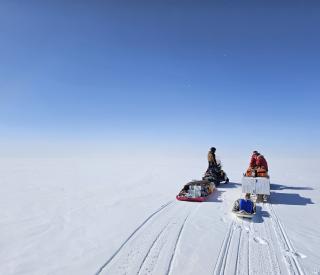
Rachel Moore spent nearly 50 days in one of the most remote places on Earth, collecting ice cores; the research has implications for climate change predictions and searching for signs of life on icy worlds.
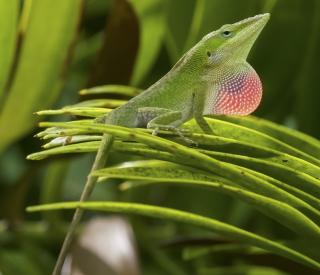
By lassoing lizards, putting tiny chips on their legs, and tracking them for three years, Georgia Tech’s James Stroud revealed why species often appear unchanged for millions of years despite Charles Darwin’s theory of constant evolution.
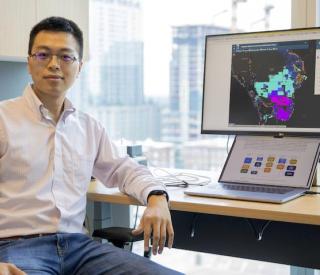
School of Computational Science and Engineering (CSE) Assistant Professor Peng Chen is co-principal investigator of a $1.5 million National Science Foundation grant to develop the CRIS-HAZARD system.
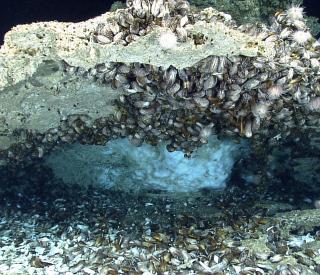
Georgia Tech researchers have uncovered eco-friendly bacterial proteins that stabilize methane clathrates, offering a green solution to climate challenges and potential implications for astrobiology.
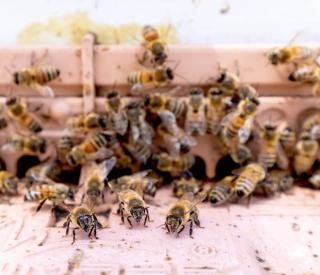
In response to changing climates, many plants and animals are moving to higher elevations, seeking cooler temperatures. But a new study finds that flying insects like bees and moths may struggle with insurmountable issues to this escape route.
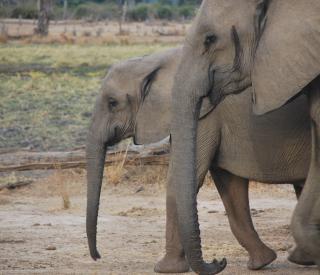
Scientists at the Georgia Institute of Technology and Max Planck Institute for Intelligent Systems in Stuttgart have published a perspectives piece on the different tools used throughout the world aiding in the conservation of wildlife and biodiversity.