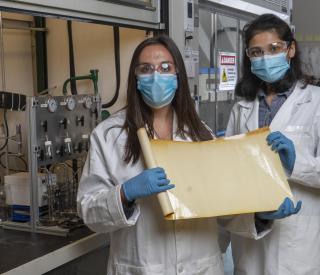
The Georgia Tech Research Institute (GTRI) is working to optimize Georgia’s EV battery supply chain by developing cost-and energy-efficient methods that pose fewer environmental risks.
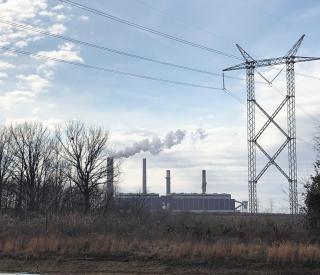
School of Earth and Atmospheric Sciences researchers find dangerous sulfates are formed, and their particles get bigger, within the plumes of pollution belching from coal-fired power plants.
Energy materials facilitate the conversion or transmission of energy. They also play an essential role in how we store energy, reduce power consumption, and develop cleaner, efficient energy solutions.
A research team led by Georgia Tech’s Hailong Chen has developed a low-cost iron chloride cathode for lithium-ion batteries, which could significantly reduce costs and improve performance for electric vehicles and large-scale energy storage systems.
Professor Anna Erickson highlights the reopening of Three Mile Island Unit 1 as a crucial step in meeting the growing energy demands of AI data centers with carbon-free nuclear power, aligning with Microsoft's sustainability goals.
A Georgia Tech-led review paper recently published in Nature Reviews Physics is exploring the ways machine learning is revolutionizing the field of climate physics — and the role human scientists might play.
As the world shifts toward electrification, the nations that command the battery supply chain will define the future of mobility, energy, and economic influence. For the U.S., the challenge isn’t just to keep pace — it’s to lead the charge.